

Nanny background check: how we vet every nanny before she enters your home
A nanny background check confirms what official records say about a person, and it’s an essential step before anyone cares for your child. It’s also only the first step. When a caregiver will know your address, your routine, your family’s habits, and the inside of your home, you need to know more than what a record says: how she handles pressure, how she handles conflict, and whether she can keep your family’s privacy. Records can’t show you that. The families we work with, many of them international and high-net-worth, hold high standards and have little time, so they want a vetting process that does the verifying for them and shows exactly how. This article walks you through ours, step by step: six filters, an integrity evaluation that puts every candidate under pressure, and real pages from the reports behind our decisions. You’ll see what happens before we introduce your Totter, our name for the nanny who joins your family, and you’ll leave with questions you can ask any agency or caregiver.
Key takeaways
- A nanny background check reviews records. It can’t show how a caregiver behaves under pressure, which is why we treat it as one filter among six.
- INEGI’s national victimization survey estimates that 93.4% of the 33.8 million crimes committed in Mexico in 2025 were never reported or never led to an investigation ( INEGI, ENVIPE 2026).
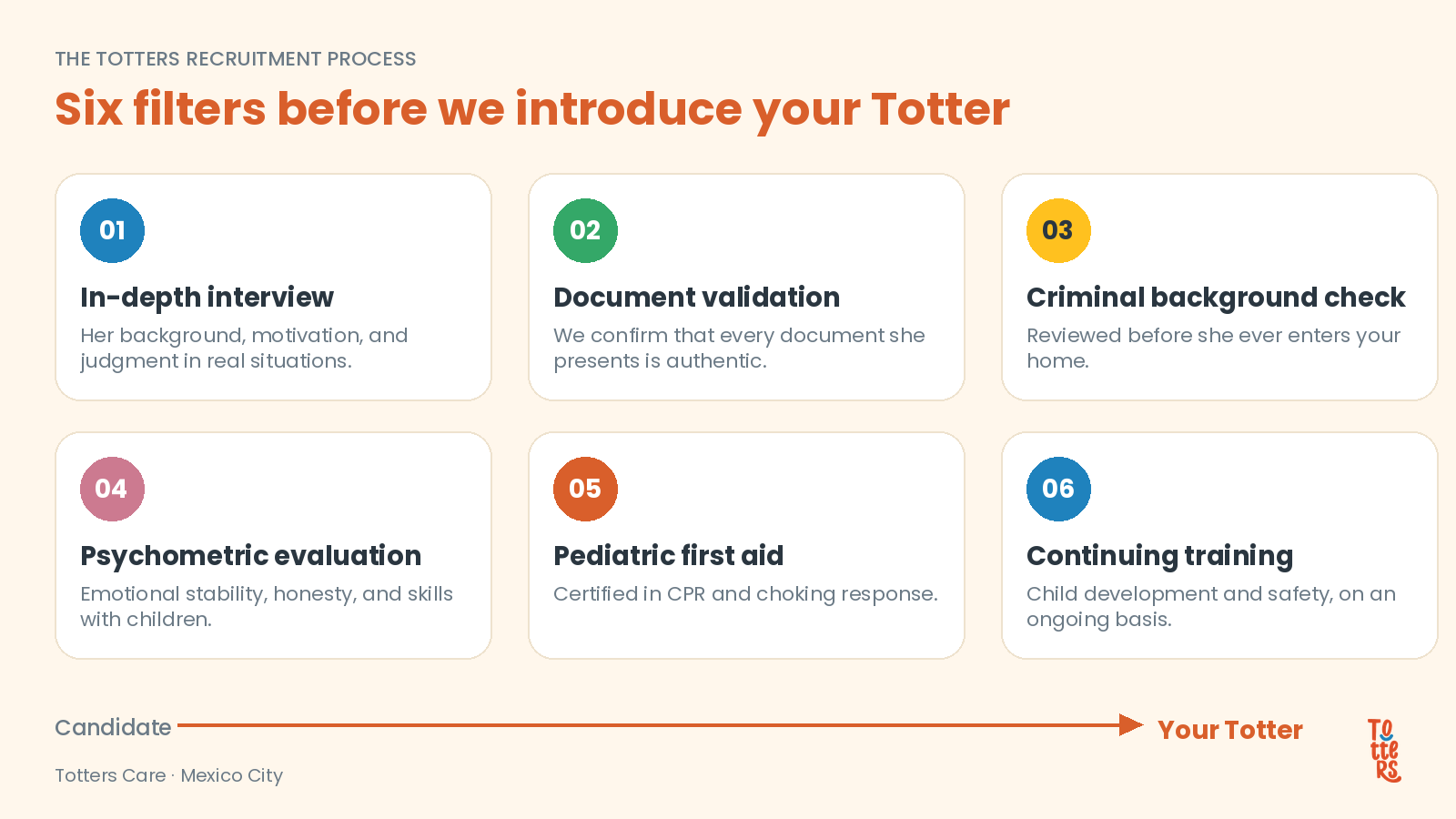
- Every Totter passes six filters: an in-depth interview, document validation, a criminal background check, a psychometric evaluation, pediatric first aid certification, and continuing training.
- Every candidate also completes an integrity evaluation that places her in situations of pressure and conflict, and you can see what its reports look like in this article.
- Theft, violence, harassment, and lack of trust are areas with no margin. Any sign of risk and she doesn’t reach your home.
- For families with high standards, vetting also protects privacy: every Totter signs a confidentiality agreement about your address, routine, and family, and an assigned coordinator handles the rest.
- You meet your Totter on a video call before she starts, and you can request a new match up to three times at no cost.
In case you’re new here, we’re Totters Care, and our story starts with our founder, Montserrat Armesto. Montse holds a master’s degree in Neuropsychology and Education and a bachelor’s degree in Pedagogy, and she has dedicated her career to early childhood. She noticed the same thing again and again: for international and high-net-worth families, choosing childcare is one of the most important and emotionally charged decisions they face.
Today the Totters team carries her vision into homes in Mexico, backed by thirteen years of caring for children. We offer in-home nanny services for families who expect a thoughtful, development-focused standard of care, and everything you’ll read below is the work that happens before a Totter ever knocks on your door.
What a nanny background check can and can’t tell you
A nanny background check reviews a candidate’s criminal record and, depending on how it’s done, her identity and history. It answers one question: does anything on file raise a concern? That question matters, and we ask it of every candidate before she enters your home.
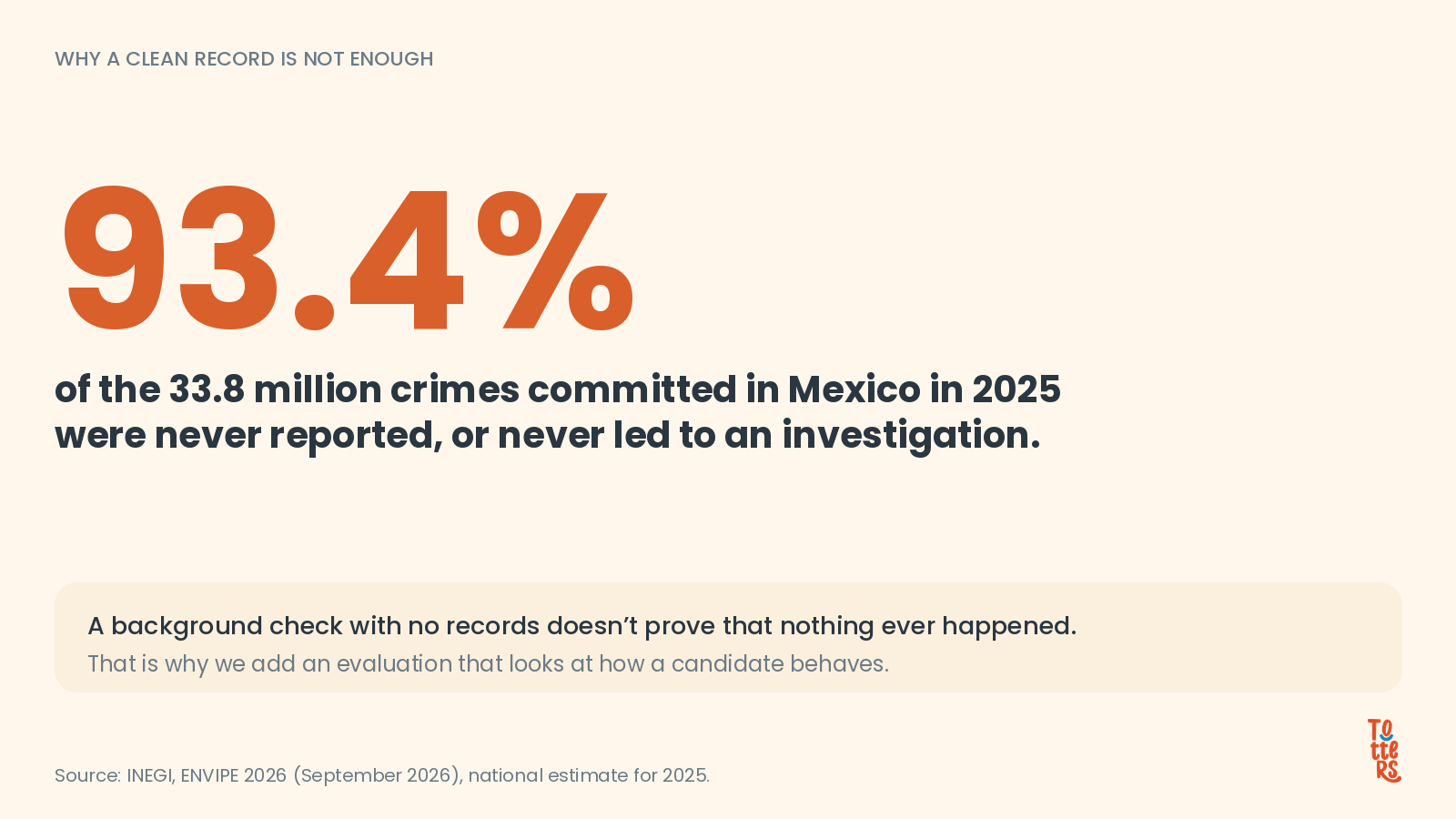
The limit comes from how much crime never reaches a file. INEGI’s national victimization survey estimates that 93.4% of the 33.8 million crimes committed in Mexico in 2025 were never reported, or the authorities never opened an investigation ( INEGI, ENVIPE 2026). A candidate with no records may simply be someone whose past never reached an authority. A clean result is good news, and it can’t be the only evidence you rely on.
That’s why our nanny vetting process treats the background check as one filter among six, and why we add an evaluation that looks at behavior.
How we vet a nanny: our six filters, step by step
Every candidate completes six filters before we present her to you. Here’s what happens at each one.
Filter 1, the in-depth interview: how she thinks
The nanny interview is where most families start, and for us it’s where we learn about her background, her motivation for working with children, and her judgment in real situations. We ask how she would handle real moments with children and we listen to how she reasons. A good answer shows us her criteria, and criteria are what you’ll rely on when you’re not at home.
Filter 2, document validation: what’s on paper is real
We confirm that the documents she presents are authentic. A name, a work history, and a certificate mean something only after someone has verified them, so we do the verifying before you ever see her profile.
Filter 3, criminal background check: before she enters your home
We review her criminal record before she enters your home. This is the check most families think of first, and for us it sits in the middle of the process, with other filters on both sides of it.
Filter 4, psychometric evaluation: emotional stability and honesty
A psychometric evaluation looks at her emotional stability, her honesty, and her skills with children. It adds a layer of information that conversation alone can’t give us.
Filter 5, pediatric first aid: ready when seconds count
Every Totter holds a pediatric first aid certification that covers CPR and choking response. When a child chokes, nobody has time to look up what to do, so we require the training before she starts.
Filter 6, continuing training: learning that doesn’t stop
Training continues after she joins us. Our Totters keep learning about child development and safety on an ongoing basis, and every protocol we write comes from thirteen years of caring for children.
What an interview can’t show: the integrity evaluation
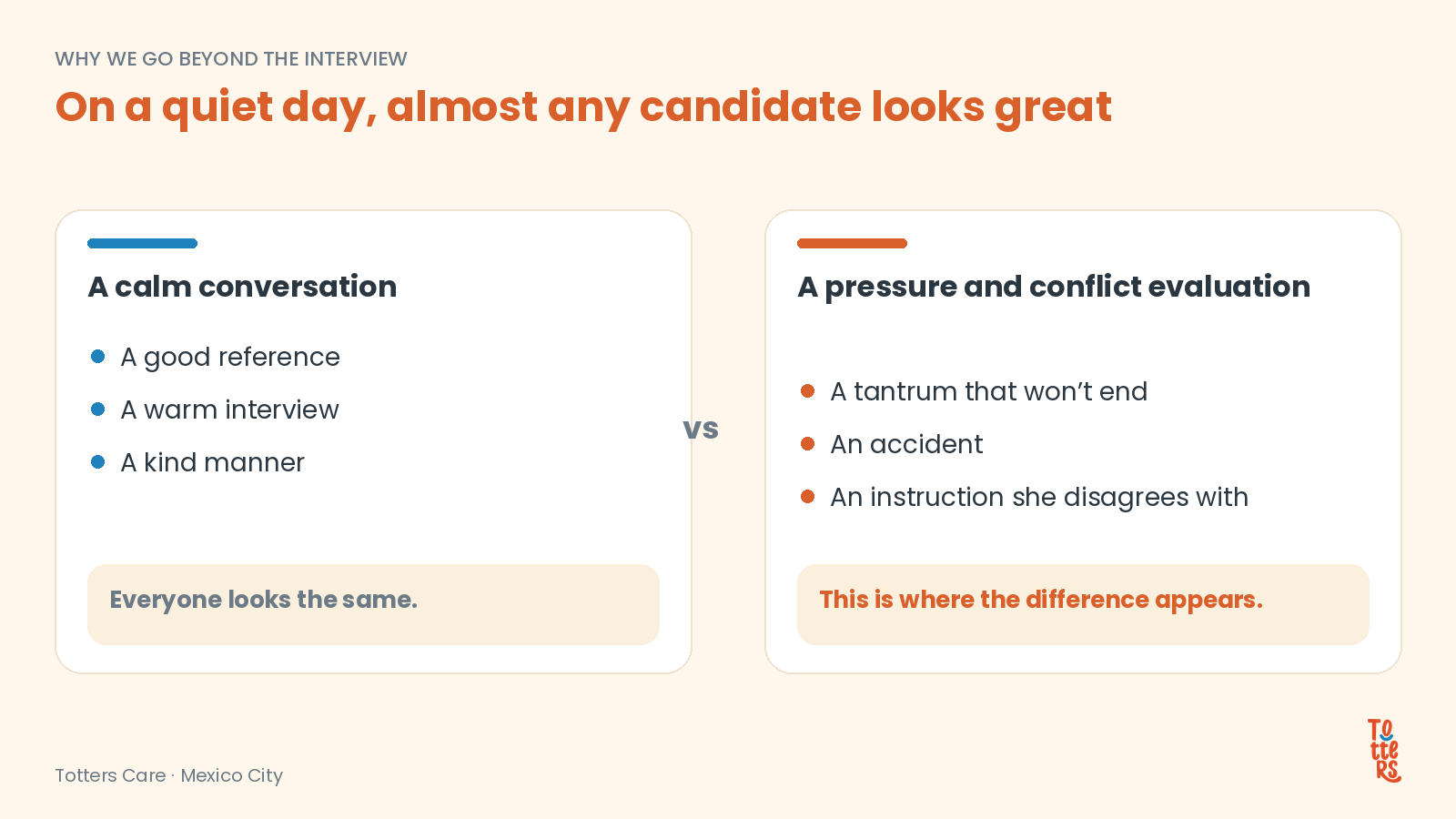
When everything goes well, almost any candidate is charming. You’re choosing someone for the harder days, though: a tantrum that won’t end, an accident, an instruction that doesn’t sit right with her. That’s why every candidate completes an integrity evaluation, the Veritas evaluation by Adam Milo, that places her in situations of pressure and conflict.
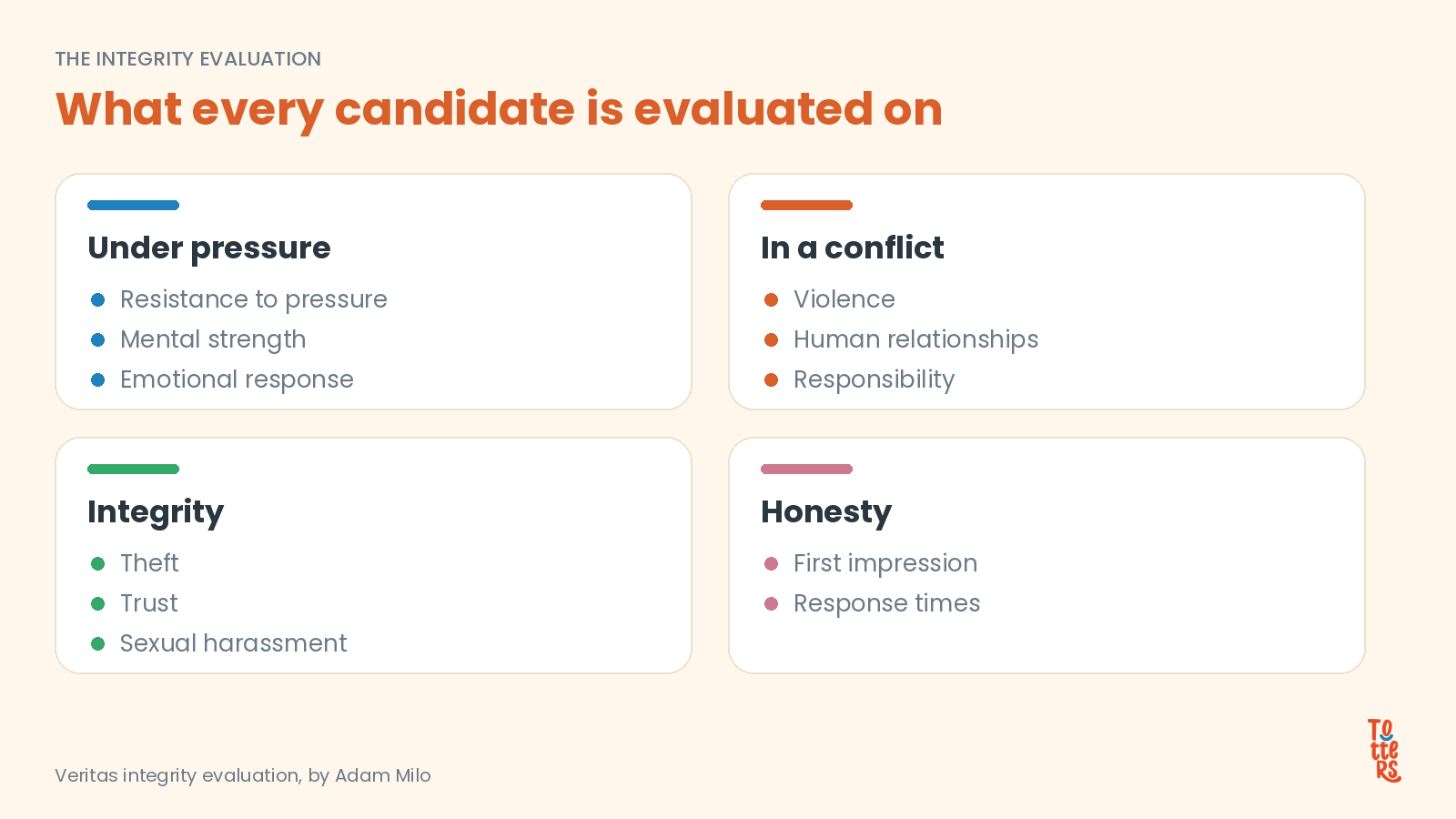
The evaluation looks at four areas. Under pressure, it looks at resistance to pressure, mental strength, and emotional response. In a conflict, it looks at violence, human relationships, and responsibility. On integrity, it looks at theft, trust, and sexual harassment. On honesty, it looks at the first impression a candidate tries to give and her response times.
A real result: recommended, charming, and high risk
One candidate came to us recommended. Her reference was good, her interview went well, and her manner was kind. Her evaluation told a different story: it detected a large deviation from the norm, flagged high risk in violence, and concluded that her admission to the position couldn’t be recommended. The interview hadn’t shown it, and the evaluation did.
Real answers: what candidates tell us
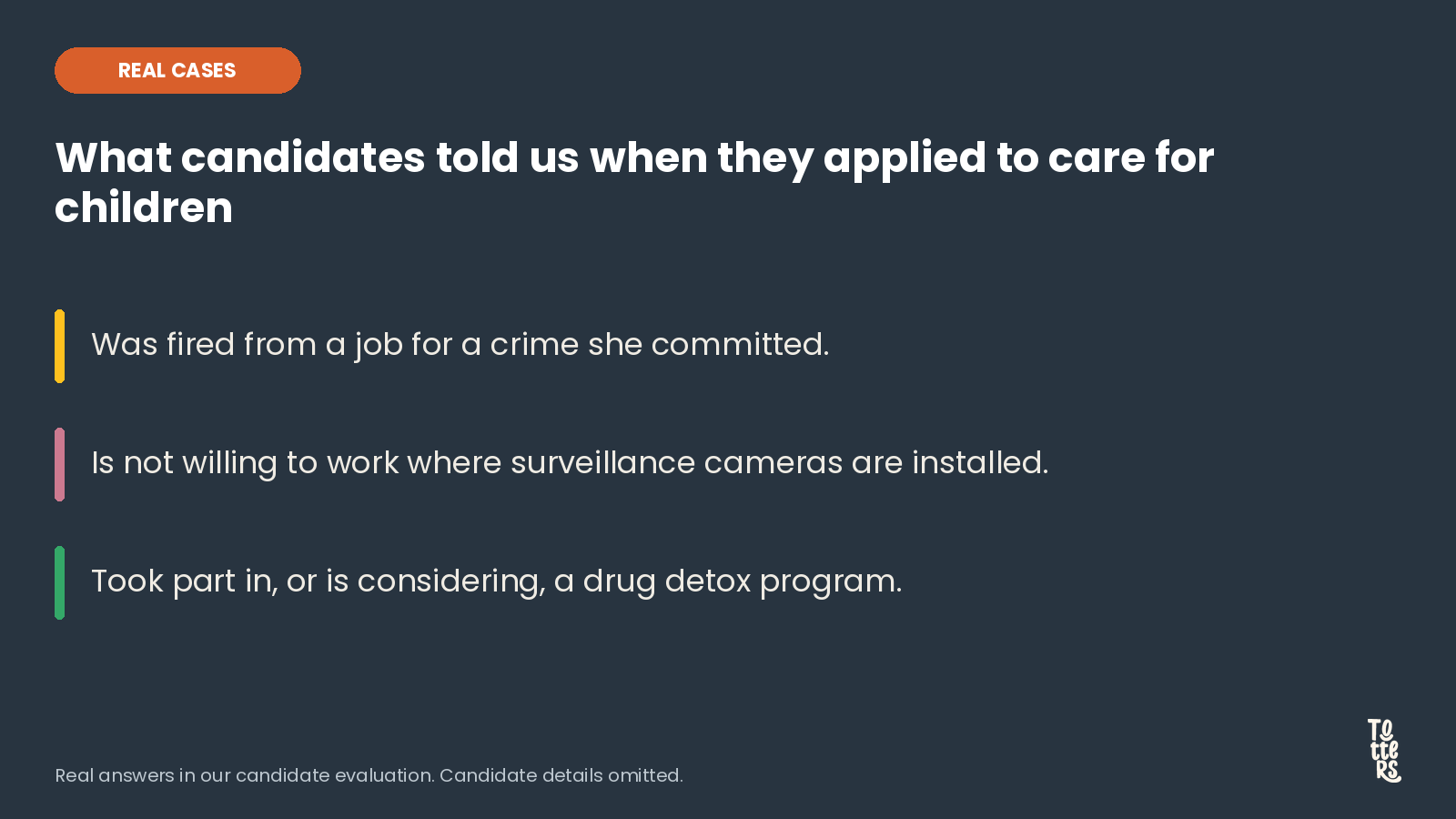
The evaluation also collects direct answers from people who apply to care for children. Among the real declarations we’ve seen, one candidate had been fired from a job for a crime she committed, one was unwilling to work anywhere with surveillance cameras, and one had taken part in, or was considering, a drug detox program. Details like these rarely come up in a friendly conversation, and you’d want to know them before someone looks after your child.
Behind the scenes: what a real evaluation report looks like
We believe you should see how this works, so here are real pages from the reports we receive. We removed every candidate detail, including names, emails, identification numbers, and photos. The reports are written in Spanish, and we added English notes to each page.
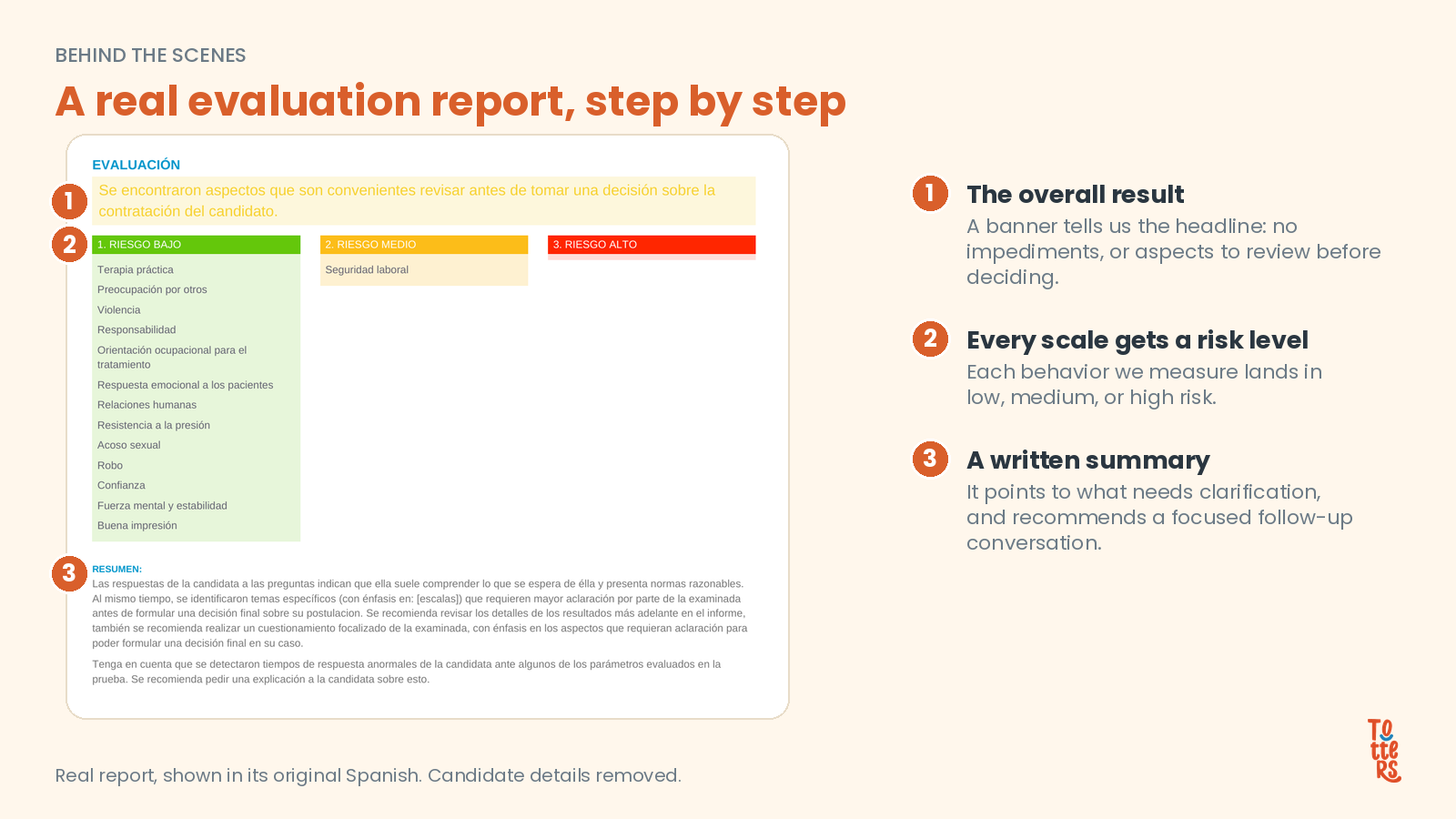
The summary page: the headline and the risk levels
Each report opens with an overall result. A banner tells us whether there are no impediments or whether there are aspects to review before deciding. Below it, every behavior sits in low, medium, or high risk, and a written summary points to what needs clarification and recommends a focused follow-up conversation.
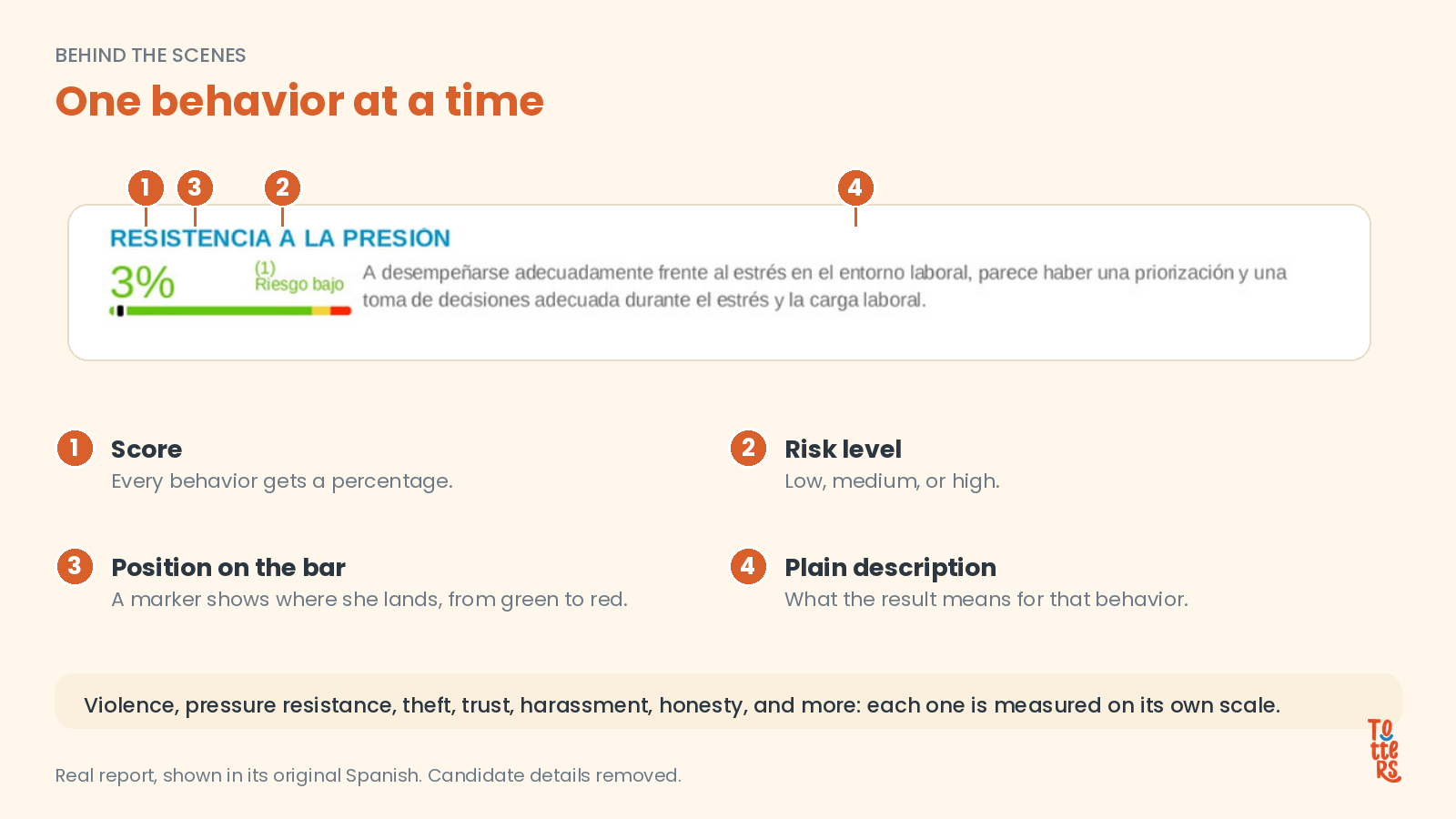
One behavior at a time: score, risk level, and a marker
Every behavior gets its own section: a percentage, a risk level, a bar from green to red with a marker, and a plain description of what the result means. Violence, pressure resistance, theft, trust, harassment, and honesty are all measured this way.
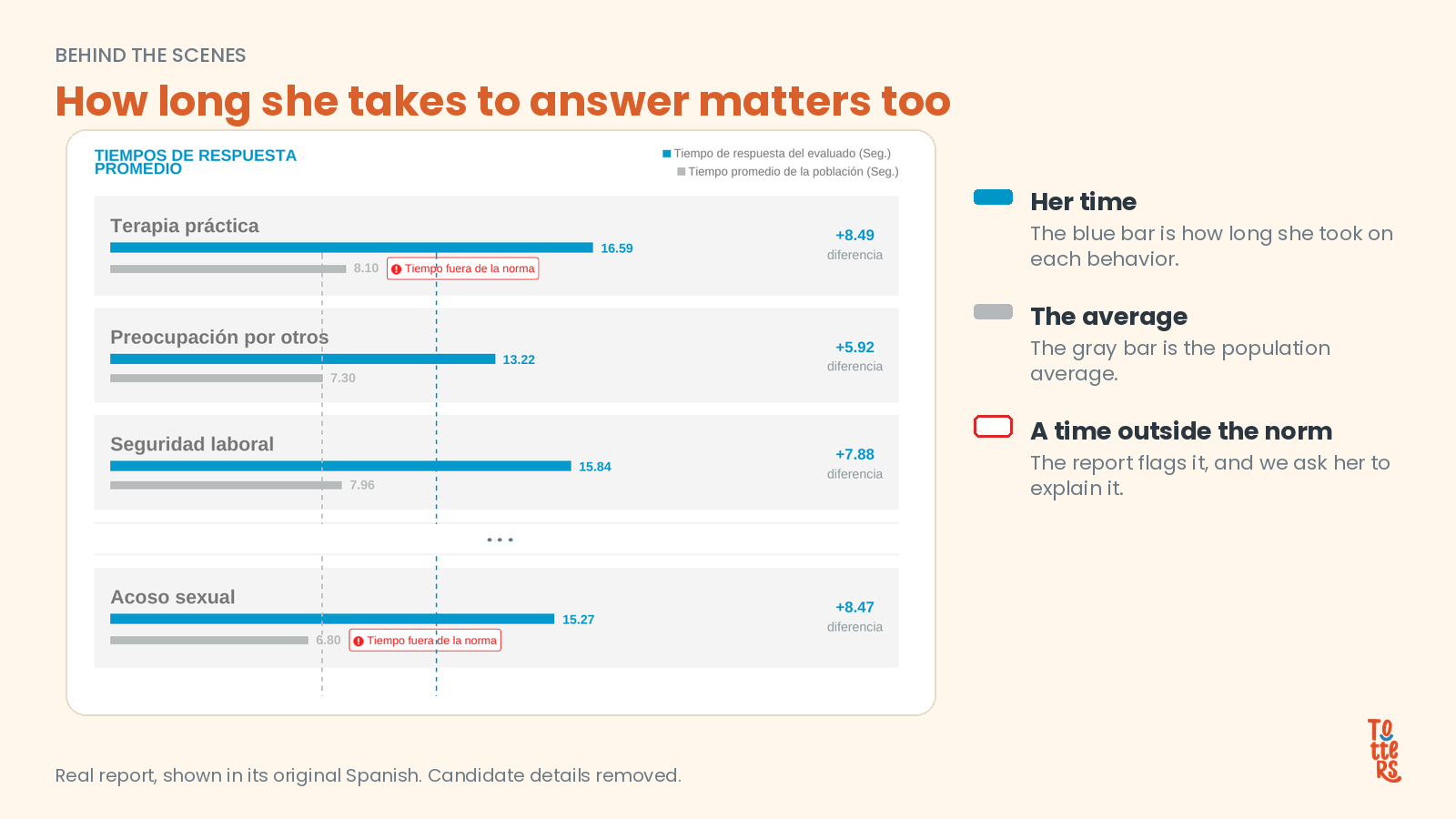
Response times: how long she takes to answer
The report also compares how long a candidate takes to answer each group of questions with the population average. When a time falls outside the norm, the report flags it and recommends asking the candidate to explain it. A flag points us to where to ask.
The follow-up kit: questions for every scale
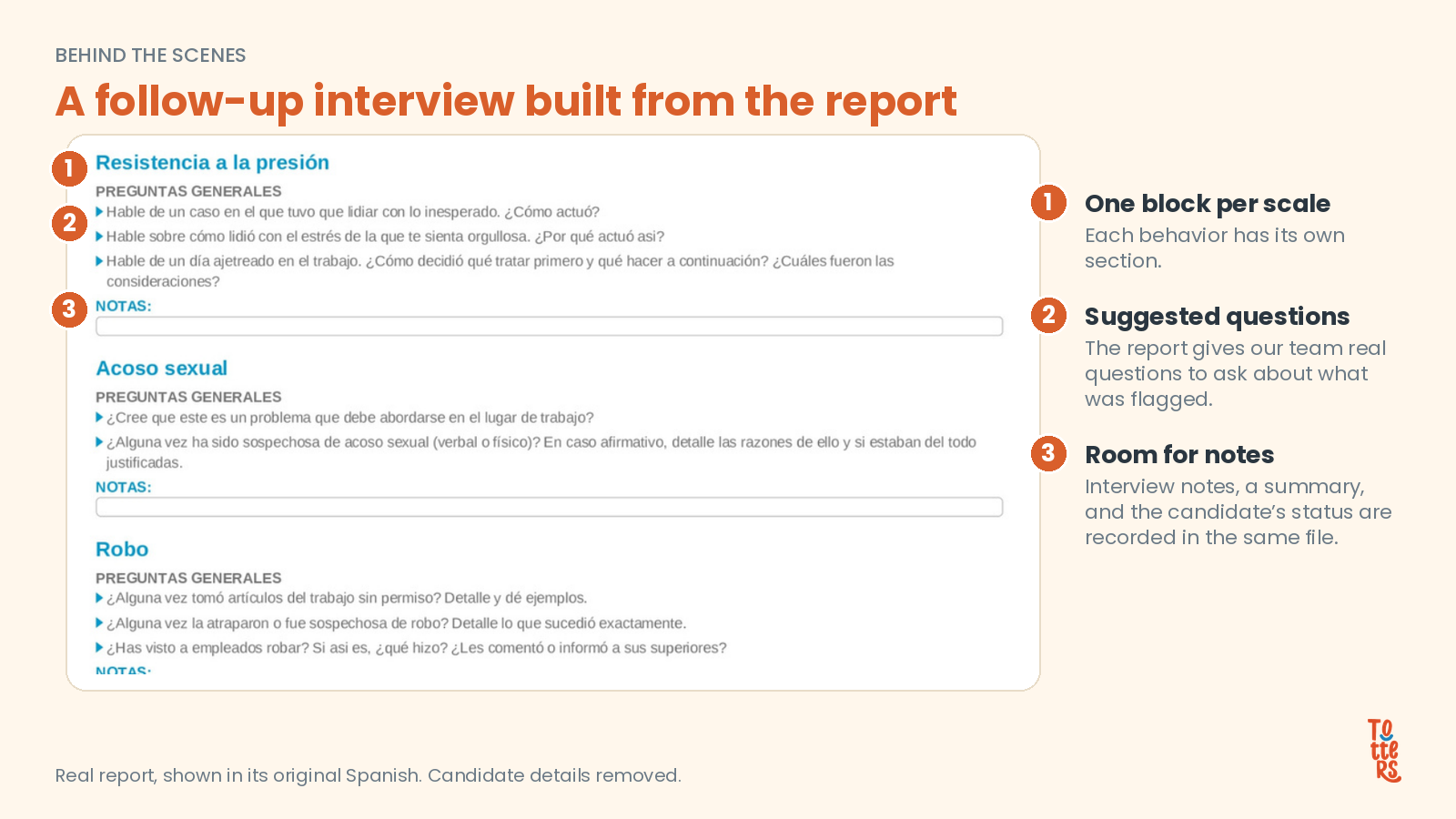
For each behavior, the report suggests questions for the interviewer, such as asking about a time she handled something unexpected or how she decided what to do first on a very busy day. Each block has space for notes, and the report closes with an interview summary and a final status.
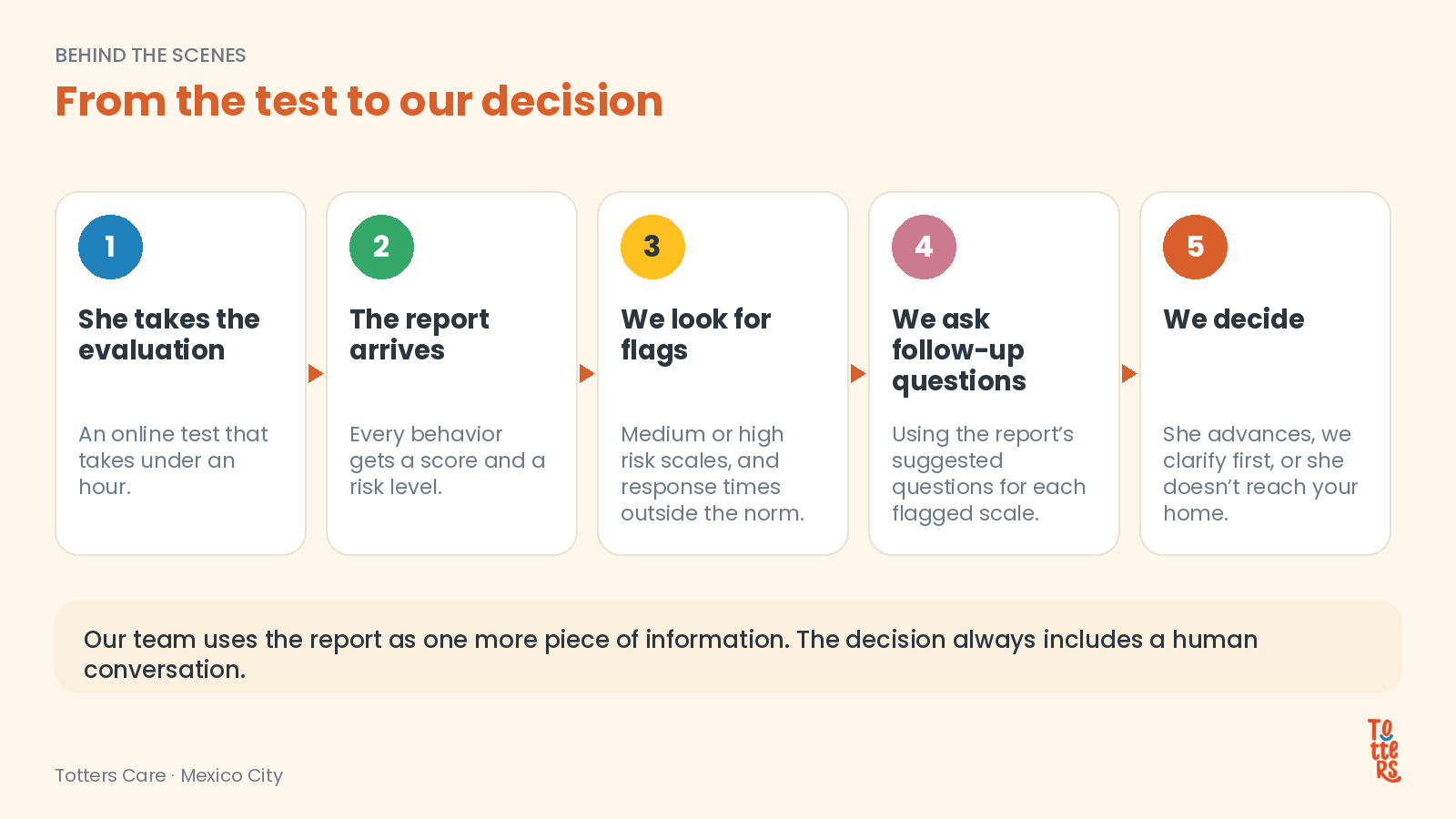
From the test to our decision
In the reports we reviewed, the evaluation lasted between 27 and 50 minutes. After she finishes, the report arrives and we look for scales at medium or high risk and for response times outside the norm. We ask follow-up questions about anything flagged, and then we decide: she advances, we clarify first, or she doesn’t reach your home. The report itself recommends using it as one factor among several, and that’s how we use it, alongside the interview, the documents, the background check, and the rest of the filters.
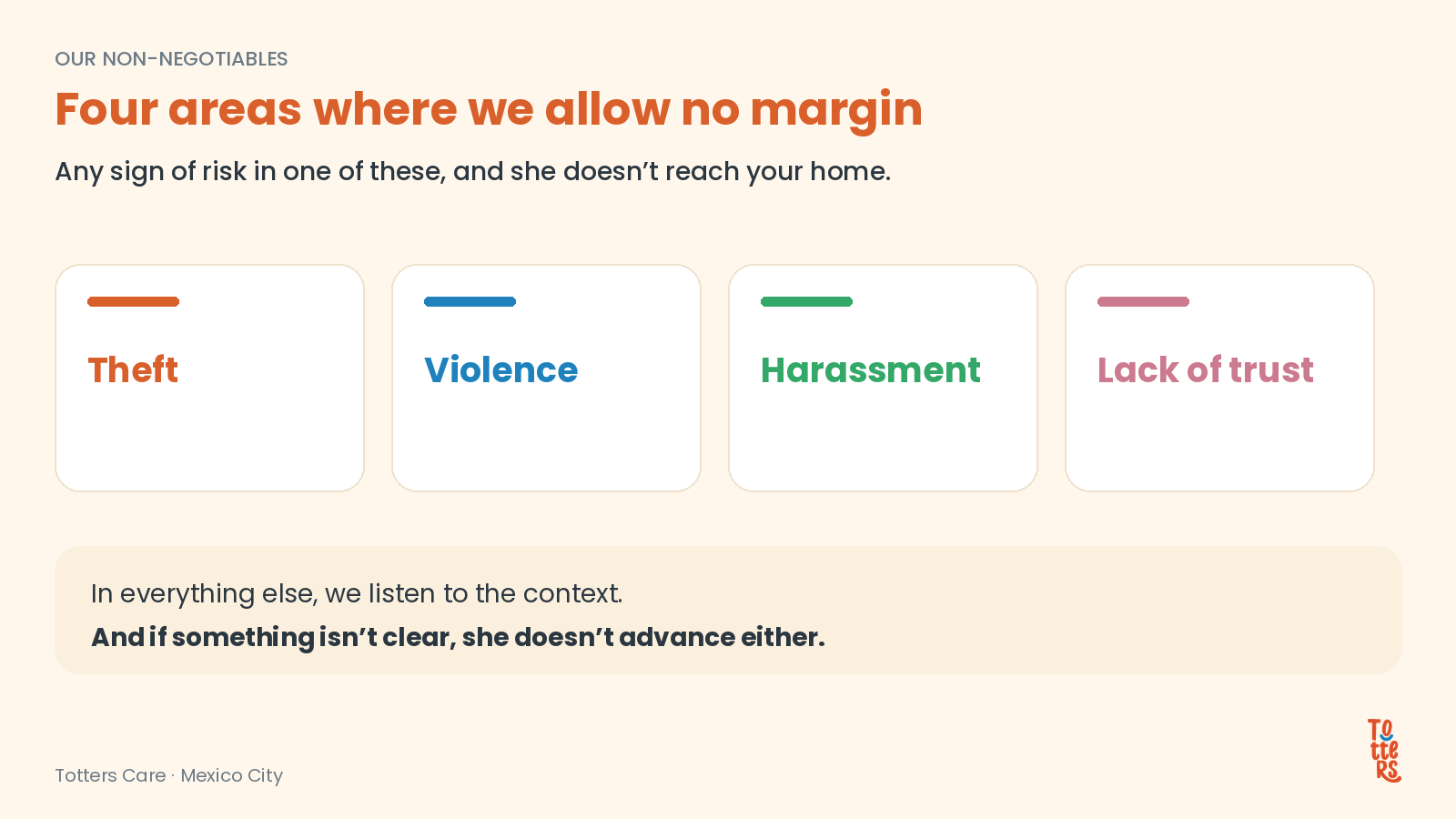
Four areas where we allow no margin
Some things we don’t negotiate. If a candidate shows any sign of risk around theft, violence, harassment, or trust, she doesn’t reach your home. In every other area we listen to the context, because people are more than a single result. And if something isn’t clear, she doesn’t advance either.
After the filters: matching, meeting, and guarantees
Once a Totter has passed all six filters, we match her with your family. You fill out an assessment about your routines, your child’s sleep and feeding, health and allergies, who may pick up your child, and what you expect from the service. That information becomes your Family Profile, and we match you with the Totter who fits your child’s age, your language, your parenting style, and the rhythm of your home. When your ideal Totter is already part of our team, a match takes two to four business days. When we select a new Totter especially for your family, it takes up to ten business days, and she passes the same six filters as everyone else.
You meet her before she starts. Our Encounter Guarantee means a video call before day one, with up to three presentations if she isn’t the right fit for you, and over the last two years nine out of ten families chose their Totter from the first presentation. Our Comfort and Safety Guarantee covers the day to day: if you don’t feel at ease once she starts, we make a new match, up to three times at no cost. In that same period, eight out of ten families stayed with their first Totter, and we’ve never reached a third change.
What high-net-worth families ask us about vetting
Many of the families we work with are high-net-worth, and they ask the sharpest questions about how we vet. Their schedules are demanding, their standards are high, and they want the freedom to decide for their own family without feeling constrained. If that sounds like your home, here’s what we’ve learned you care about most.
Discretion: who has access to your home
You’ll probably ask about discretion first: who enters your home, what our team knows about your family, and what stays private. Each Totter signs a confidentiality agreement about your address, your routine, and your family, during and after the service. We take no photos and publish nothing about your child without your written authorization, which you can withdraw at any time, and your information lives in your Family Profile with personal access that can’t be transferred.
A team behind her: coordination that solves
You receive an excellent Totter, and you also receive a coordination team behind her. You have an assigned coordinator for your family, a substitute you approve if your Totter can’t come, written protocols for emergencies, and, if you want 24/7 care, a team of several Totters. When a need comes up, you tell your coordinator and we confirm it according to your Totter’s availability. Payments, schedules, and adjustments go through your coordinator too, so your relationship with your Totter stays centered on your child.
Your decisions: freedom without friction
Your week changes often, and our service is built to bend with you. You meet your Totter before she starts, you approve every update to your Family Profile and every substitute, and you can request a new match up to three times at no cost. The structure is ours to maintain, and the decisions stay with you.
How to hire a nanny: questions to ask any agency
Whether you’re comparing a nanny agency or hiring on your own, a few questions tell you a lot about how a caregiver was vetted. Ask how documents are verified and who verifies them. Ask what the screening includes beyond a criminal record, and whether anyone evaluates how a candidate behaves under pressure and in conflict. Ask whether pediatric first aid certification is required and how it’s confirmed, and whether you can meet the caregiver before her first day.
Then ask how the agency protects your family’s privacy: whether caregivers sign a confidentiality agreement, who can take or publish photos, and who can access your information. Ask who coordinates the service, who steps in when your caregiver can’t come, and which written protocols exist for emergencies such as choking, a fall, a fever, or an allergic reaction. When a nanny reference check is the only filter, and the references came from people the candidate chose, you’re seeing one side of the story. A complete answer to each of these questions is a good sign, and you can use the same questions with us.
Do you know how your child’s caregiver reacts on a hard day?
Choosing the person who looks after your child carries real weight, especially when she will know your home, your routine, and your family’s privacy. You’re already managing a lot, and you deserve a process that does the verifying for you and shows you how it works.
Getting started takes three steps: we schedule a call, you complete your assessment, and we introduce you to your Totter. Montse would love to meet your family. Call 55 3717 2675 or write to hello@totterscare.com, and together we’ll define your service.

Hello I ´m Montse Armesto
Pedagogue & Child Development Specialist, focused on Child Neuropsychology and Neurodevelopment. Certified in Positive & Gentle Parenting.
At Totters, we believe childcare can be so much more than supervision. By combining child development science and evidence-based early childhood practices, we create enriching in-home experiences that support children’s learning, confidence, curiosity, and overall development.
Download my free guide






Disclaimer:
All advice is not legal advice and consult with your local entities for accurate data the blog is for informational purposes only
Some of the links on this page may be affiliate links, though not all of them are. This means we may earn a small commission if you use certain links, at no extra cost to you. We only include services or resources we believe may be useful, but you should always compare options and choose what works best for your situation.