

Nanny vs. babysitter vs. au pair in Mexico: what you are actually choosing between
We can save you the part of this search that will not help you.
In Mexico, nanny and babysitter are used interchangeably. Say either one and everybody understands you mean someone who comes to your home and takes care of your children. Say “niñera” or “nana” and you have said both at once. There is no licence attached to either word, no registry behind them, and no agreed definition that anyone in this market is working from.
The au pair is a different story. It is a figure you will find all over the internet and almost nowhere in Mexico, because the arrangement does not exist here in any recognised form.
Which means the article you were probably expecting, the one that sorts these into tidy job categories, would be describing a distinction that does not exist in Mexico. Most of those articles are written for the United States, where the words carry tax implications and agency definitions. They do not travel.
What matters here is the agreement you reach with the person and what your family actually needs: how many hours, whether you need the same person every week, and how you will know whether you can trust whoever turns up. This guide defines each term so you can read what you find online, then shows you how to decide, and what each arrangement costs in practice.
Totters was founded by Montserrat Armesto, a pedagogue and specialist in child neuropsychology, for parents who want to be deeply present and deeply ambitious. We name our own services after the stage your child is in and the hours you need, not after a job title, precisely because the titles here mean whatever the person saying them wants them to mean. Our in-home childcare program is built around that.
What is a nanny?
In the way the word is used in the United States, a nanny is a household employee who looks after your children on an ongoing, regular schedule. She is usually the same person every week, often for full days, paid a set amount monthly, with tax obligations attached to the arrangement.
In Mexico the closest word is niñera, and it covers a much wider range. Someone advertised as a nanny may have a degree in early childhood education. Someone else advertised as a nanny may have no training at all. The word tells you that she will be present regularly. It does not tell you how prepared she is.
What is a babysitter?
A babysitter is casual and hourly. Someone comes for an evening, a weekend afternoon, a work event or a stretch of travel, and you are buying safety and supervision for a defined block of time. Continuity is not part of what you are paying for.
In the United States that distinction does real work, because a tax code made it exist. Here, none of that scaffolding is present. The same woman will be described as a niñera by your neighbour, a babysitter by the building administrator and a nanny by the agency that sent her, and all three are describing the identical arrangement.
What is an au pair?
Short answer: it is not really a thing here, and most of what you will find online about it does not apply to Mexico.
The au pair arrangement you have read about, where a young person lives with your family in exchange for room, board, a stipend and limited childcare hours, runs on formal visa programmes in the United States and much of Europe. Those programmes are the reason it works there and the reason the search results are full of agencies. Mexico has no equivalent programme at that scale, so placements are rare, informal and unsupported.
There is also a mismatch worth naming. An au pair is, by design, a cultural exchange participant rather than a trained childcare professional. If you are relocating with a two year old into a new language and want someone who understands what a child does during a transition, that is not the arrangement you are looking for, however appealing the cost looks.
If you do find a live-in arrangement here, it will almost certainly be a live-in caregiver rather than an au pair, which is a different thing with different expectations around hours and pay.
Common differences, and why they blur in Mexico
Here is how the three are usually described, and what that looks like in practice here.
| Arrangement | Nanny | Babysitter | Au pair |
|---|---|---|---|
| Typical hours | Fixed weekly schedule, often full days | Occasional, by the block | Limited hours, lives with the family |
| Continuity | The same person every week | Often a different person each time | The same person, for a defined stay |
| How it is paid | Monthly | By the hour | Stipend plus room and board |
| What you can assume about preparation | Nothing, until you verify it | Nothing, until you verify it | A cultural exchange participant, not a trained professional |
| In Mexico | Usually called a niñera | Usually called a niñera too | Not a recognised arrangement |
The practical consequence: do not filter candidates by the word in their profile, and do not assume a higher rate is attached to a more serious title. Filter on what you can verify, which is the subject of most of this article.
What defines the arrangement is the agreement
Because the labels carry no fixed meaning here, the agreement does the work the title would do elsewhere. Whatever you call her, put these in writing before the first day:
- The days and hours, and what happens when you need more or less.
- Exactly which tasks belong to the role.
- How and when she is paid, and what happens with holidays and absences.
- Who covers when she cannot come.
- How either of you gives notice if it stops working.
Two families can use the same word and mean completely different arrangements. Two families can use different words and have the same one. The agreement is what tells them apart.
Pros and cons of each arrangement
Since the words blur, it helps to think in terms of what each arrangement gives you and what it costs you.
A nanny, meaning someone ongoing
- Pros: one adult learns your child, notices when something is off, and builds a relationship that holds across the week. Routines stay consistent, which matters most for a child who has just changed countries.
- Cons: it is a larger commitment, in money and in trust. If the person leaves, the disruption falls on your child, and you are the one who has to find cover when she is sick.
A babysitter, meaning someone occasional
- Pros: flexible and easy to arrange for an evening or a trip. You pay only for the hours you use.
- Cons: there is little continuity, so each time you are asking a near stranger to learn your child quickly. Booked by the hour, it also costs more per hour than an ongoing arrangement.
An au pair, where it applies
- Pros: a live-in presence and a cultural exchange, with lower cash cost on paper.
- Cons: in Mexico it is informal and unsupported, and an au pair is not a trained childcare professional. For a young child in transition, that is a significant gap.

The first real question: how many hours, and how often the same person?
This is the decision the vocabulary was pretending to make for you. There are essentially two arrangements, and what you call them does not matter.
The first is occasional. Someone comes for an evening, a weekend afternoon, a work event, a stretch of travel. You are buying safety and supervision for a defined block of time, priced by the hour, and continuity is not part of what you need.
The second is ongoing. The same person, a fixed weekly schedule, paid monthly. What you are buying here is not extra hours. It is that one adult is present often enough to learn your child rather than manage him.
Why continuity is the variable that matters
A caregiver who sees your child four days a week notices when something is off. She knows this particular whining means tired and that one means overwhelmed. She can tell you he has started sharing attention differently, or that he was quieter this week than last.
For a child who has just changed countries, that continuity does real work, and it cannot be assembled four hours at a time from different people. If your child is mid transition, continuity is not a luxury feature of the arrangement. That is most of the point.
Most families end up needing both
Most parents we speak to end up needing both arrangements rather than choosing between them. One person holds the week. Someone else covers the anniversary dinner. Asking one to do the other's job is where the frustration usually starts.
How will you know who you are letting in?
Whatever you call the role, the person will be alone in your home with your children. There is no licence, no registry and no required certification for any version of this work, so whatever a candidate tells you about herself stands unchallenged unless you challenge it.
Three things are available to you, and they matter more than any title on a profile.
- Confirm documents at the source. Call the institution that issued the first aid certification and check it is current. A certificate is easy to print, and with nothing anywhere to check it against, the paper proves only that paper exists.
- Call references yourself, using a number you found where you can rather than only the one you were handed. Ask what kind of family she would not be right for.
- Commission a reliability assessment. A validated instrument returns a percentage-based reading of tendency toward violence, toward theft, toward dishonesty, susceptibility to bribery and capacity for manipulation. Insist it is validated for the Mexican population and interpreted by someone qualified.
Scale the effort to the arrangement. For an occasional evening sitter, references and a first aid check are proportionate. For someone who will hold your week for the next two years, all three are worth doing properly, and it is also worth knowing the nanny red flags international families should recognise before a warm first meeting does your thinking for you.
Do they also do housework?
Child related tasks, yes. General household work, no, unless it was explicitly agreed and explicitly paid for.
The standard boundary is anything belonging to your child. Preparing their meals and clearing up afterwards. Their laundry. Tidying the spaces they played in. Organising their clothes and bags.
Where it goes wrong is drift, and it is especially common here because the roles of childcare and household employment have historically been blended. A week where she happens to do the family's dishes becomes an expectation, then a tension nobody names. The cleanest fix is a written list at the start, revisited honestly when your needs change. If you need household support as well as childcare, hire for both openly and pay for both.
Does the label matter more than the process behind the person?
Ten years in this work have changed what we pay attention to. Nanny, babysitter, niñera, au pair. None of it does anything for you. What protects your child is the process standing behind the person: serious selection, real management of the relationship once it begins, continuous training, and somebody genuinely supervising the work after everyone else has stopped paying attention.
Whichever arrangement you land on, the quality of it is decided by who was selected and what supports her afterwards.
Still not sure which one your week needs?
The question underneath all of this is rarely logistical. It is whether the person in your home on an ordinary Tuesday afternoon, when you are not there and nothing remarkable is happening, is someone you trust with the version of your child that only appears when the day gets hard.
That is the standard we hire to. A Totters placement includes the full screening, deliberate matching, a personalised developmental plan for your child, ongoing training and professional supervision of the caregiver, substitute coverage when she cannot come, and our team handling schedule changes and the conversations that create friction inside a household. For a newborn in the house, specialised infant care is its own service, and for a defined season our short-term and temporary option covers it without a long commitment.
We work with families throughout the country, whether you are settling into a building in Mexico City, finding your footing in Guadalajara, Jalisco, or choosing the quieter streets of San Miguel de Allende, and we will tell you honestly what your week actually needs, whatever you decide to call it.

Hello I ´m Montse Armesto
Pedagogue & Child Development Specialist, focused on Child Neuropsychology and Neurodevelopment. Certified in Positive & Gentle Parenting.
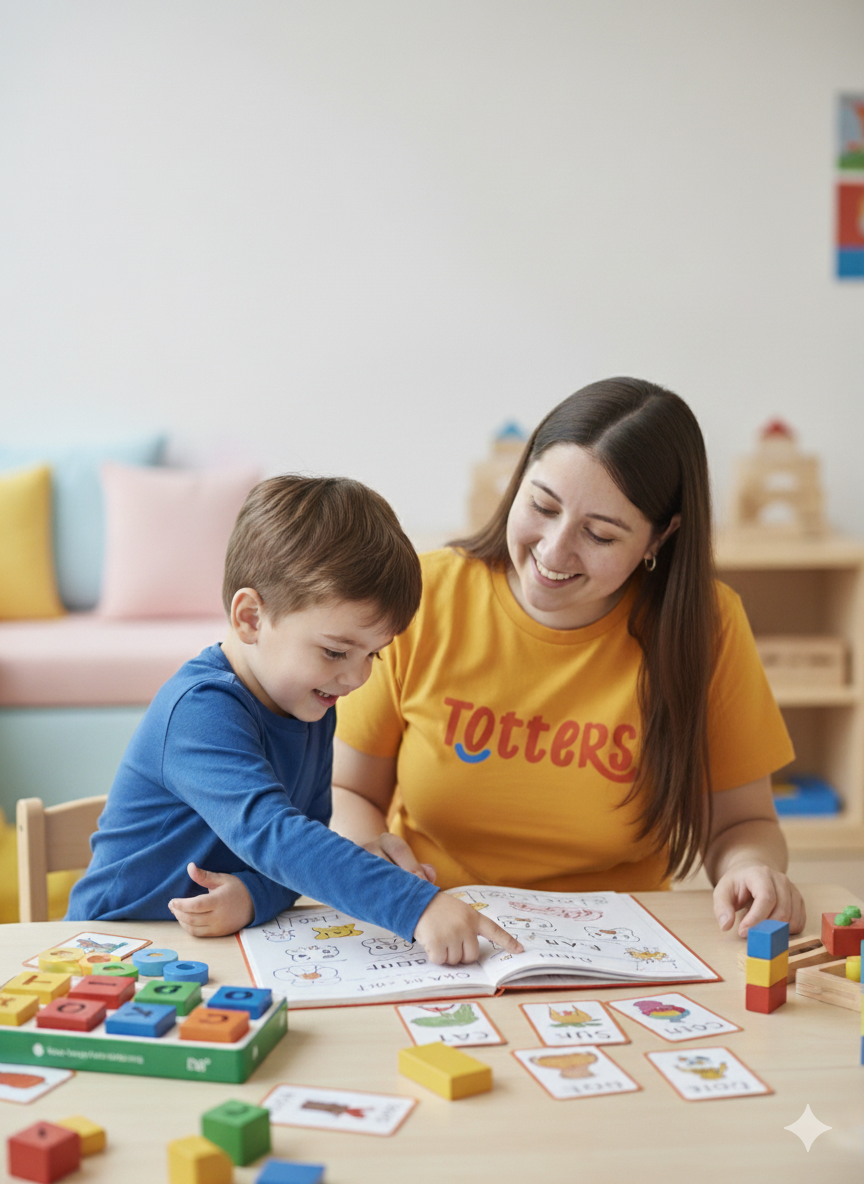
At Totters, we believe childcare can be so much more than supervision. By combining child development science and evidence-based early childhood practices, we create enriching in-home experiences that support children’s learning, confidence, curiosity, and overall development.
Download my free guide





Disclaimer:
All advice is not legal advice and consult with your local entities for accurate data the blog is for informational purposes only
Some of the links on this page may be affiliate links, though not all of them are. This means we may earn a small commission if you use certain links, at no extra cost to you. We only include services or resources we believe may be useful, but you should always compare options and choose what works best for your situation.